
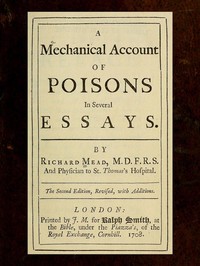
A Mechanical Account of Poisons in Several Essays
Written by Richard Mead
Chaptra reads alongside you — AI insights, chapter breakdowns and reader discussions for every book. Join free
About this book
Read it with a club
Small groups reading the same books and talking as they go.


News
- 4 members
- 1,813 discussions
- Active Sep 11
Read A Mechanical Account of Poisons in Several Essays alongside people who are reading it too.
Also here: News Bulletin, Just Joking....
Chaptra Prime — paid clubs, every club feature, and unlimited reading support, for $5 a month or $60 once.
See PrimeReading guide
Themes, characters and key ideas in A Mechanical Account of Poisons in Several Essays, written by Chaptra AI.
- about 18 hours
- advanced
- analytical
- didactic
- scientific
Richard Mead's "A Mechanical Account of Poisons in Several Essays" is an early 18th-century scientific treatise that endeavors to understand the nature and effects of various poisons through empirical observation and mechanical reasoning. Rejecting the superstitions prevalent in earlier eras, Mead systematically investigates how poisons, particularly viper venom, interact with the human body on a physiological level. The work outlines the symptoms of envenomation, explores the vital biological role of venom for the creature, and seeks to uncover the precise mechanisms by which it causes harm. Ultimately, it aims to pave the way for more effective treatments and a more rational approach to toxicology, marking a significant departure from previous, often mystical, explanations.
“My Design in the following Essays is, to give a more intelligible Account of Poisons, and their Effects, than has been hitherto published.”
Key themes
- The Scientific Method and Empiricism
- This theme is central to Mead's entire project. He explicitly advocates for a method of inquiry based on direct observation, experimentation (or analysis of observed effects), and logical deduction, rather than relying on inherited wisdom, folklore, or speculative theories. His detailed examination of viper venom symptoms and physiological interactions serves as a practical demonstration of this empirical approach, aiming to uncover the 'how' and 'why' through demonstrable evidence.
- Reason vs. Superstition
- Mead's work is a direct challenge to the prevailing superstitious beliefs and unverified remedies associated with poisons in his era. He consciously seeks to replace fear, folklore, and magical thinking with rational explanation and scientific understanding. By detailing the mechanical operations of poisons, he aims to strip away their mystical aura and present them as phenomena governed by natural laws, thereby empowering knowledge over ignorance.
- The Nature of Disease and Toxicology
- At its heart, the book is an early treatise on toxicology, aiming to understand the classification, effects, and potential treatments of toxic substances. Mead delves into the specific properties of poisons, their sources, and the precise ways they manifest as disease states within the body. This theme explores the fundamental questions of what makes a substance poisonous, how it causes harm, and how that harm might be counteracted, thereby laying foundational elements for the discipline of toxicology.
Worth discussing
How does Mead's approach exemplify the shift from traditional, superstitious medical practices to modern, empirical science in the 18th century?
Chapter-by-chapter breakdowns, character arcs and the full thematic analysis come with a free account.
Discussions
No one has started one yet
Questions this book opens up
No discussions yet
Be the first to start a discussion about this book!
Sign up to start the discussionReviews
No reviews yet
Be the first to review this book!