
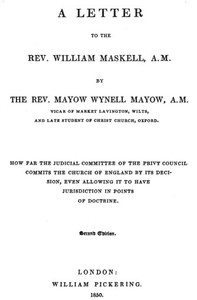
A Letter to the Rev. William Maskell, A.M.: How far the Judicial Committee of the Privy Council commits the Church of England by its decision, even allowing it to have jurisdiction in points of doctrine
Written by Mayow Wynell Mayow
Chaptra reads alongside you — AI insights, chapter breakdowns and reader discussions for every book. Join free
About this book
Reading guide
Themes, characters and key ideas in A Letter to the Rev. William Maskell, A.M.: How far the Judicial Committee of the Privy Council commits the Church of England by its decision, even allowing it to have jurisdiction in points of doctrine, written by Chaptra AI.
- about 3 hours
- advanced
- Analytical
- Concerned
- Rhetorical
Mayow Wynell Mayow's "A Letter to the Rev. William Maskell, A.M." is a pivotal mid-19th-century theological polemic addressing the profound crisis within the Church of England concerning the authority of the Judicial Committee of the Privy Council. The letter rigorously debates whether the Privy Council's decisions on doctrinal matters, particularly baptismal regeneration, truly commit the Church to heresy, even if the court holds jurisdiction. Mayow argues that despite potential ambiguity in church formularies, the Church's underlying intent and true doctrines remain orthodox, urging it to clearly assert its theological stance. He advocates for a convocation to definitively address these urgent matters, thereby safeguarding the Church's integrity and autonomy against perceived secular encroachment.
“How far the Judicial Committee of the Privy Council commits the Church of England by its decision, even allowing it to have jurisdiction in points of doctrine.”
Key themes
- Ecclesiastical Authority vs. State Authority
- This is the central tension of the letter, exploring the fundamental conflict between the spiritual authority of the Church to define its own doctrines and the legal authority of a secular state court to interpret those doctrines. Mayow argues for the Church's right to self-determination in matters of faith.
- Doctrinal Purity and Interpretation
- The letter deeply engages with the challenge of maintaining theological orthodoxy and clarity, specifically through the lens of baptismal regeneration. It examines how foundational religious texts (formularies) are interpreted, particularly when their language might be ambiguous, and the necessity for the Church to clearly articulate its beliefs.
- The Nature of Church Identity and Autonomy
- Mayow's letter is fundamentally a plea for the Church of England to safeguard its distinct identity and its right to govern itself in spiritual matters. It explores what it means for a church to be truly 'the Church' when its doctrines are being judged by an external, secular body, and the importance of internal mechanisms for self-definition.
Worth discussing
To what extent should secular legal bodies have authority over the doctrinal interpretations of religious institutions?
Chapter-by-chapter breakdowns, character arcs and the full thematic analysis come with a free account.
Discussions
No one has started one yet
Questions this book opens up
No discussions yet
Be the first to start a discussion about this book!
Sign up to start the discussionReviews
No reviews yet
Be the first to review this book!