
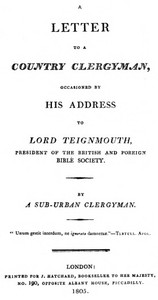
A letter to a country clergyman, occasioned by his address to Lord Teignmouth
Written by John Owen
Chaptra reads alongside you — AI insights, chapter breakdowns and reader discussions for every book. Join free
About this book
Reading guide
Themes, characters and key ideas in A letter to a country clergyman, occasioned by his address to Lord Teignmouth, written by Chaptra AI.
- about 3 hours
- advanced
- argumentative
- critical
- persuasive
Owen's "A Letter to a Country Clergyman" is an early 19th-century argumentative pamphlet defending the British and Foreign Bible Society against criticisms leveled by a country clergyman. Writing as 'A Sub-Urban Clergyman,' Owen refutes claims that Lord Teignmouth's presidency of the Society threatens the Church of England, arguing instead that widespread Bible distribution fosters unity among Christian sects. Through a blend of satire and rhetorical questions, he champions the notion that access to scripture promotes genuine Christian charity and that fears of doctrinal corruption are unfounded. The pamphlet thus advocates for an inclusive approach to scripture circulation, critically examining institutional loyalties versus the broader mission of faith.
“Is the mere act of placing the Holy Scriptures into the hands of a devout Christian truly a threat to the established order, or rather its most profound bulwark?”
Key themes
- Church Authority vs. Scripture Access
- This is the central thematic conflict. The pamphlet explores the tension between the established Church of England's desire to maintain doctrinal control and its authority, and the Bible Society's mission to provide universal, unmediated access to the Holy Scriptures. Owen argues that widespread access is a strength, not a threat, to true faith.
- Interdenominational Unity
- Owen strongly advocates for the idea that providing a common text (the Bible) can foster unity and cooperation among various Christian denominations, rather than exacerbating their differences. He sees the Bible Society as a vehicle for transcending sectarian divides.
- The Nature of Christian Charity
- Owen argues that true Christian charity is exemplified by the Bible Society's work: the benevolent act of sharing the word of God. He implies that restricting access out of fear is antithetical to this charitable spirit.
Worth discussing
How does Owen use satire and rhetorical questions to strengthen his argument against the country clergyman?
Chapter-by-chapter breakdowns, character arcs and the full thematic analysis come with a free account.
Discussions
No one has started one yet
Questions this book opens up
No discussions yet
Be the first to start a discussion about this book!
Sign up to start the discussionReviews
No reviews yet
Be the first to review this book!