
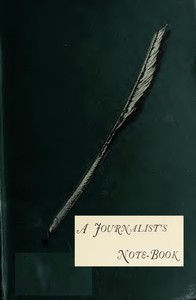
A Journalist's Note-Book
Written by Frank Frankfort Moore
Chaptra reads alongside you — AI insights, chapter breakdowns and reader discussions for every book. Join free
About this book
Read it with a club
Small groups reading the same books and talking as they go.


News
- 4 members
- 1,813 discussions
- Active Sep 11
Read A Journalist's Note-Book alongside people who are reading it too.
Also here: News Bulletin, Just Joking....
Chaptra Prime — paid clubs, every club feature, and unlimited reading support, for $5 a month or $60 once.
See PrimeReading guide
Themes, characters and key ideas in A Journalist's Note-Book, written by Chaptra AI.
- about 8 hours
- intermediate
- humorous
- satirical
- reflective
Frank Frankfort Moore's "A Journalist's Note-Book" is a late 19th-century collection of reflections and anecdotes offering a humorous and satirical look into the evolving world of journalism. The work explores the profession's transition from disrepute to respectability, challenging lingering societal misconceptions about journalists. Through personal experiences and observations, Moore critiques the trade's challenges, quirks, and oddities, using wit to highlight the intricacies of writing and public reaction to news. The book serves as both an entertaining memoir and a subtle commentary on media ethics and the professionalization of reporting during its era.
“The world, in its infinite wisdom, often confuses the messenger with the message, and the journalist, alas, often bears the brunt of both.”
Key themes
- The Evolution and Professionalization of Journalism
- This theme explores how journalism transitioned from a less respected, often disreputable trade to a profession striving for respectability and defined standards in the late 19th century. Moore reflects on the societal perceptions, ethical considerations, and the internal struggles within the industry to establish its legitimacy.
- Societal Perception vs. Reality
- Moore consistently highlights the disparity between how journalists are perceived by the public (often with suspicion or disdain) and the realities of their work, which often involves dedication, skill, and a unique perspective. This theme underscores the challenges of any profession that operates under public scrutiny.
- The Power and Pitfalls of Satire and Humor
- Moore employs humor and satire throughout the book, not merely for entertainment but as a critical tool to expose absurdities, critique societal norms, and offer a more palatable way to address serious issues within journalism and society at large. This theme explores the effectiveness and limitations of wit as a form of social commentary.
Worth discussing
How does Moore's depiction of 19th-century journalism compare to contemporary media practices and challenges?
Chapter-by-chapter breakdowns, character arcs and the full thematic analysis come with a free account.
Discussions
No one has started one yet
Questions this book opens up
No discussions yet
Be the first to start a discussion about this book!
Sign up to start the discussionReviews
No reviews yet
Be the first to review this book!