
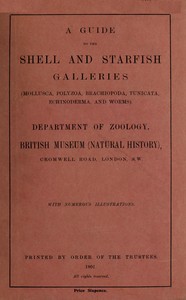
A guide to the shell and starfish galleries : $b (Mollusca, Polyzoa, Brachiopoda, Tunicata, Echinoderma, and Worms)
Written by E. A. (Edgar Albert) Smith,British Museum (Natural History). Department of Zoology,F. J. (Francis Jeffrey) Bell,R. (Randolph) Kirkpatrick
Chaptra reads alongside you — AI insights, chapter breakdowns and reader discussions for every book. Join free
About this book
Reading guide
Themes, characters and key ideas in A guide to the shell and starfish galleries : $b (Mollusca, Polyzoa, Brachiopoda, Tunicata, Echinoderma, and Worms), written by Chaptra AI.
- about 10 hours
- intermediate
- informative
- scientific
- educational
E. A. Smith's "A Guide to the Shell and Starfish Galleries" is a foundational early 20th-century scientific publication from the British Museum (Natural History), serving as an exhaustive guide to its zoological exhibitions. It meticulously details and classifies various marine invertebrates, including mollusks, echinoderms, polyzoans, brachiopods, tunicates, and worms. The guide reflects the era's profound interest in natural history and systematic taxonomy, providing visitors and students with a structured exploration of these diverse life forms. Through detailed descriptions of anatomical features, biology, and systematic arrangement, the work underscores the museum's role in public education and scientific documentation of biodiversity.
“The systematic arrangement of mollusks on display reflects the ongoing scientific endeavor to classify and understand the diversity of life.”
Key themes
- Taxonomy and Classification
- The central theme of the guide is the systematic classification of marine invertebrates. It meticulously details the hierarchical arrangement of species into genera, families, and phyla, reflecting the scientific endeavor to categorize and understand biodiversity. This theme highlights the human impulse to order the natural world.
- Public Science Education
- The guide serves as a prime example of early 20th-century public science education. It aims to make complex scientific information accessible to a broad audience, from casual museum visitors to dedicated students, thereby fostering an appreciation for natural history and scientific inquiry. It underscores the museum's role as an educational institution.
- The Fascination with Natural History
- Implicit throughout the guide is the deep human fascination with the natural world, particularly the beauty and diversity of marine life. The very existence of such an extensive exhibition and a detailed guide speaks to a societal interest in collecting, observing, and understanding the myriad forms of life on Earth.
Worth discussing
How does a museum guide like this contribute to public understanding of science, both in its time and today?
Chapter-by-chapter breakdowns, character arcs and the full thematic analysis come with a free account.
Discussions
No one has started one yet
Questions this book opens up
No discussions yet
Be the first to start a discussion about this book!
Sign up to start the discussionReviews
No reviews yet
Be the first to review this book!