
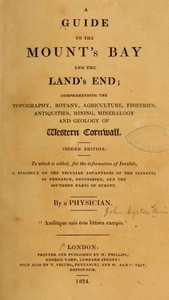
A Guide to the Mount's Bay and the Land's End: Comprehending the topography, botany, agriculture, fisheries, antiquities, mining, mineralogy and geology of West Cornwall
Written by John Ayrton Paris
Chaptra reads alongside you — AI insights, chapter breakdowns and reader discussions for every book. Join free
About this book
Reading guide
Themes, characters and key ideas in A Guide to the Mount's Bay and the Land's End: Comprehending the topography, botany, agriculture, fisheries, antiquities, mining, mineralogy and geology of West Cornwall, written by Chaptra AI.
- about 8 hours
- advanced
- Informative
- Descriptive
- Scholarly
John Ayrton Paris's "A Guide to the Mount's Bay and the Land's End" is an early 19th-century comprehensive guidebook offering a detailed exploration of Western Cornwall. It meticulously covers the region's topography, botany, geology, agriculture, fisheries, and antiquities, aiming to inform both curious tourists and individuals seeking a mild climate for health reasons. The guide positions Penzance as a central hub for exploration, reflecting the era's growing interest in natural sciences and the influence of local geological societies. Through vivid descriptions and scientific insights, Paris constructs a rich portrait of West Cornwall, blending practical advice with scholarly observation. The work serves as both a practical travel companion and a valuable historical document of the region's natural and cultural landscape.
“The Mount's Bay and the Land's End district presents a combination of picturesque beauty and scientific interest, rarely equalled.”
Key themes
- Scientific Inquiry and Observation
- A core theme is the detailed scientific exploration of the region. Paris, influenced by the Royal Geological Society, delves into geology, mineralogy, botany, and other natural sciences with precision. The guide serves as an educational tool, encouraging readers to observe and understand the natural world through a scientific lens, reflecting the intellectual curiosity of the early 19th century.
- Nature's Beauty and Sublimity
- The guide consistently highlights the captivating landscapes of West Cornwall, from its rugged coastlines to its diverse flora. Paris often uses vivid language to describe the picturesque and sometimes awe-inspiring natural features, inviting readers to appreciate the aesthetic and emotional impact of the environment. This theme is central to attracting tourists and emphasizing the region's unique appeal.
- Health and Climate
- The guide explicitly targets invalids and those seeking winter residence, emphasizing the 'noted mild climate' of West Cornwall. This theme underscores the 19th-century belief in the therapeutic qualities of specific environments and the practice of 'climate cures.' Paris details the benefits of the region's weather, positioning it as a haven for recuperation and wellness.
Worth discussing
How does Paris balance scientific reporting with an appeal to tourists and invalids? What does this reveal about early 19th-century attitudes towards nature and health?
Chapter-by-chapter breakdowns, character arcs and the full thematic analysis come with a free account.
Discussions
No one has started one yet
Questions this book opens up
No discussions yet
Be the first to start a discussion about this book!
Sign up to start the discussionReviews
No reviews yet
Be the first to review this book!