
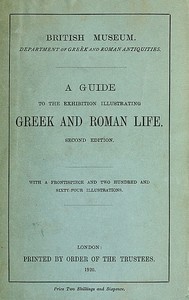
A Guide to the Exhibition Illustrating Greek and Roman Life
Written by British Museum. Department of Greek and Roman Antiquities
Chaptra reads alongside you — AI insights, chapter breakdowns and reader discussions for every book. Join free
About this book
Reading guide
Themes, characters and key ideas in A Guide to the Exhibition Illustrating Greek and Roman Life, written by Chaptra AI.
- about 8 hours
- intermediate
- Informative
- Educational
- Historical
A Guide to the Exhibition Illustrating Greek and Roman Life" is an early 20th-century publication by the British Museum, serving as a comprehensive companion for visitors to an exhibition focused on the daily lives of ancient Greeks and Romans. This guide moves beyond mere artistic achievements to encompass the public and private spheres of these cultures, presenting a diverse collection of antiquities. It elucidates the exhibition's organization, grouping artifacts into categories like political, social, and religious practices to provide a coherent and accessible view of ancient life. The work acknowledges the collaborative efforts of museum staff in its creation, functioning as both an educational resource for the public and a historical document reflecting early 20th-century museology.
“This exhibition aims to present a diverse collection of antiquities that reflect the public and private lives of these cultures, rather than solely their artistic achievements.”
Key themes
- Everyday Life in Antiquity
- The central theme of the guide and the exhibition it accompanies is to illuminate the practical, domestic, and public aspects of ancient Greek and Roman existence. It moves beyond wars, emperors, and grand art to showcase the lives of ordinary people, their homes, tools, customs, and daily routines, making history more relatable and human.
- Public Education and Museum Curation
- This theme explores the role of museums as educational institutions and the methodologies employed in curating and presenting historical knowledge to the general public. The guide itself is a primary tool for this educational mission, designed to make complex historical periods accessible and engaging for a broad audience.
- Historical Interpretation and Material Culture
- The guide implicitly addresses how historians and archaeologists interpret the past through the surviving material record. It highlights that objects are not just relics but primary sources of information about social structures, beliefs, and daily practices. The act of selecting, categorizing, and presenting artifacts within an exhibition is an active process of historical interpretation.
Worth discussing
How has the approach to museum exhibitions about ancient civilizations evolved since the early 20th century?
Chapter-by-chapter breakdowns, character arcs and the full thematic analysis come with a free account.
Discussions
No one has started one yet
Questions this book opens up
No discussions yet
Be the first to start a discussion about this book!
Sign up to start the discussionReviews
No reviews yet
Be the first to review this book!