
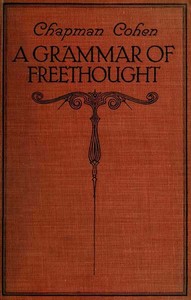
A Grammar of Freethought
Written by Chapman Cohen
Chaptra reads alongside you — AI insights, chapter breakdowns and reader discussions for every book. Join free
About this book
Reading guide
Themes, characters and key ideas in A Grammar of Freethought, written by Chaptra AI.
- about 10 hours
- advanced
- Thought-provoking
- Analytical
- Challenging
Chapman Cohen's "A Grammar of Freethought" is an early 20th-century philosophical treatise advocating for a worldview based on reason, skepticism, and critical examination rather than traditional religious authority. The work systematically challenges conventional religious beliefs, positing them as historical sources of error and limitations to human understanding. Cohen traces the supposed decline of religious influence as societies advance scientifically and socially, arguing that progress necessitates an abandonment of deities. Ultimately, the book aims to establish a framework for personal and societal growth rooted in rational inquiry, asserting that Freethought is essential for moral and intellectual development.
“Freethought is not merely the absence of belief, but the active exercise of reason, unfettered by dogma or authority.”
Key themes
- Freethought and Skepticism
- This is the core theme, advocating for an intellectual approach free from dogma and authority. Cohen champions skepticism as the primary tool for critical examination, urging readers to question conventional beliefs and seek understanding through rational inquiry and evidence rather than blind faith. He presents Freethought not as mere disbelief, but as an active, constructive process for intellectual growth and societal advancement.
- Reason vs. Authority
- A central conflict explored is the tension between knowledge derived from rational thought and that which is dictated by religious or traditional authority. Cohen argues that humanity's intellectual progress is marked by a gradual shift from subservience to authority (religious leaders, sacred texts) towards independent reasoning and empirical evidence. He positions reason as the liberating force against the constraints imposed by dogmatic authority.
- Critique of Religion
- Cohen's work is fundamentally a detailed critique of traditional religious beliefs. He examines the historical prevalence of religion, not to celebrate it, but to expose its perceived shortcomings, logical inconsistencies, and its role as a 'source of colossal mistakes in human understanding.' The critique extends to how religion potentially hinders moral and social development by fostering irrationality and discouraging critical thought, thus presenting it as an impediment to human progress.
Worth discussing
How does Cohen define 'Freethought' and how does his definition compare to modern understandings of atheism or agnosticism?
Chapter-by-chapter breakdowns, character arcs and the full thematic analysis come with a free account.
Discussions
No one has started one yet
Questions this book opens up
No discussions yet
Be the first to start a discussion about this book!
Sign up to start the discussionReviews
No reviews yet
Be the first to review this book!