
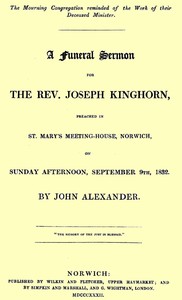
A funeral sermon for the Rev. Joseph Kinghorn: preached in St. Mary's Meeting-house, Norwich, on Sunday afternoon, September 9th, 1832
Written by John Alexander
Chaptra reads alongside you — AI insights, chapter breakdowns and reader discussions for every book. Join free
About this book
Reading guide
Themes, characters and key ideas in A funeral sermon for the Rev. Joseph Kinghorn: preached in St. Mary's Meeting-house, Norwich, on Sunday afternoon, September 9th, 1832, written by Chaptra AI.
- about 2 hours
- advanced
- reverent
- solemn
- reflective
John Alexander's 'A funeral sermon for the Rev. Joseph Kinghorn' is a solemn and reflective discourse delivered on September 9th, 1832, commemorating the life and ministry of the esteemed Baptist theologian, Joseph Kinghorn. Preached in St. Mary's Meeting-house, Norwich, the sermon serves as both a eulogy and a theological reflection on mortality, Christian hope, and the enduring legacy of a faithful servant of God. Alexander meticulously recounts Kinghorn's virtues, his dedication to his pastoral duties, and his significant contributions to his denomination, intertwining biographical details with scriptural exposition to offer comfort to the bereaved congregation and instruction to all listeners. It is a poignant example of 19th-century Nonconformist pulpit oratory, encapsulating the spiritual and intellectual values of the era.
“"We mourn not as those who have no hope, for precious in the sight of the Lord is the death of his saints."”
Key themes
- Christian Hope and Resurrection
- Counterbalancing the theme of mortality, the sermon powerfully asserts the Christian doctrine of resurrection and the hope of eternal life. Kinghorn's death is presented not as an ultimate end, but as a transition to a glorious reward in Christ. This theme provides the ultimate source of comfort and spiritual strength for the bereaved.
- Mortality and the Brevity of Life
- The sermon grapples directly with the inevitability of death and the transient nature of human existence. It acknowledges the sorrow of loss but frames mortality within a Christian worldview, emphasizing that earthly life is but a preparation for eternity. This theme serves as a foundational premise for the sermon's broader message of hope.
- The Exemplary Life and Legacy of a Minister
- A core aspect of the sermon is the detailed commendation of Rev. Joseph Kinghorn's life and ministry, presenting him as a model of piety, scholarship, and pastoral dedication. This theme explores the qualities deemed essential for a faithful servant of God in the 19th century and how such a life leaves an enduring spiritual and intellectual legacy within the community.
Worth discussing
How does Alexander balance eulogy with theological instruction in the sermon?
Chapter-by-chapter breakdowns, character arcs and the full thematic analysis come with a free account.
Discussions
No one has started one yet
Questions this book opens up
No discussions yet
Be the first to start a discussion about this book!
Sign up to start the discussionReviews
No reviews yet
Be the first to review this book!