
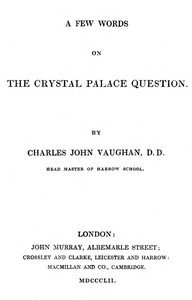
A Few Words on the Crystal Palace Question
Written by C. J. (Charles John) Vaughan
Chaptra reads alongside you — AI insights, chapter breakdowns and reader discussions for every book. Join free
About this book
Reading guide
Themes, characters and key ideas in A Few Words on the Crystal Palace Question, written by Chaptra AI.
- about 2 hours
- advanced
- reflective
- didactic
- earnest
C. J. Vaughan's "A Few Words on the Crystal Palace Question" is an early 19th-century theological discourse addressing the contentious proposal to open the Crystal Palace on Sundays. Vaughan critiques this initiative, viewing it as a direct threat to the spiritual significance and traditional observance of the Christian Sabbath, which he carefully distinguishes from the Jewish Sabbath. He argues that while individual freedoms are important, the collective societal practice of a day of rest is vital for spiritual rejuvenation and honoring God. The text navigates the complex interplay between evolving societal norms, the pursuit of leisure, and the enduring principles of Christian faith, advocating for a balance that preserves Sunday's sanctity amidst an increasingly secularizing world.
“The Christian Sabbath is not a legal imposition, but a spiritual privilege, a divine gift for man's rest and refreshment.”
Key themes
- Sabbath Observance and the Sanctity of Sunday
- This is the central theme, exploring the theological and ethical imperative of dedicating Sunday as a day of rest and worship. Vaughan argues for its divine origin and its necessity for spiritual health, distinguishing it from the Old Testament Sabbath while maintaining its fundamental principle. He sees the proposed opening of the Crystal Palace as a direct challenge to this sacred practice.
- Modernity vs. Tradition
- The discourse is set against the backdrop of 19th-century industrialization and the rise of new forms of public entertainment, symbolized by the Crystal Palace. Vaughan represents a traditionalist viewpoint, expressing concern that the rapid changes and secularizing trends of modernity threaten established religious and social norms. He grapples with how to reconcile progress with enduring spiritual values.
- Leisure, Recreation, and Spiritual Well-being
- Vaughan meticulously examines the purpose and appropriate use of leisure time, particularly on Sundays. He differentiates between mere entertainment or recreation and true spiritual rest and rejuvenation. He argues that while leisure is necessary, its quality and context are crucial for human flourishing, advocating for activities that uplift the spirit rather than merely distract the mind, viewing Sunday as an opportunity for spiritual growth.
Worth discussing
How does Vaughan distinguish between the Jewish and Christian Sabbath, and why is this distinction crucial to his argument?
Chapter-by-chapter breakdowns, character arcs and the full thematic analysis come with a free account.
Discussions
No one has started one yet
Questions this book opens up
No discussions yet
Be the first to start a discussion about this book!
Sign up to start the discussionReviews
No reviews yet
Be the first to review this book!