
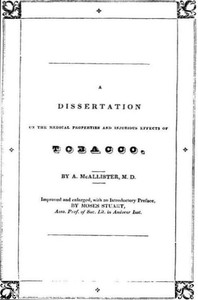
A Dissertation on the Medical Properties and Injurious Effects of the Habitual Use of Tobacco
Written by A. (Alvan) McAllister
Chaptra reads alongside you — AI insights, chapter breakdowns and reader discussions for every book. Join free
About this book
Reading guide
Themes, characters and key ideas in A Dissertation on the Medical Properties and Injurious Effects of the Habitual Use of Tobacco, written by Chaptra AI.
- about 7 hours
- advanced
- instructive
- cautionary
- serious
A. McAllister's early 19th-century 'A Dissertation on the Medical Properties and Injurious Effects of the Habitual Use of Tobacco' serves as a pioneering scientific and moral critique of tobacco consumption. McAllister meticulously details the chemical makeup and potent narcotic effects of tobacco, arguing forcefully against its casual use due to its capacity to induce a range of adverse health issues, including nausea, dyspepsia, and nervous system disorders. Beyond physiological harm, the dissertation explores the broader social and moral implications, controversially linking tobacco use to an increased susceptibility to alcohol dependence. Through a combination of medical evidence and anecdotal accounts, McAllister passionately advocates for the complete abandonment of tobacco, positioning it as a profound detriment to both individual well-being and the moral fabric of society, thereby challenging the prevailing view of tobacco as an innocuous social custom.
“Tobacco, far from being an innocuous pleasure, harbors potent narcotic effects that insidiously undermine the constitution.”
Key themes
- Public Health and Preventive Medicine
- McAllister's work is fundamentally a treatise on public health, aiming to educate and warn the populace about the dangers of a widely accepted substance. He advocates for a proactive approach to health, emphasizing prevention over cure, by identifying and campaigning against practices detrimental to well-being. This positions the dissertation as an early and significant piece of preventive medicine literature.
- The Dangers of Habit and Addiction
- The dissertation places significant emphasis on the 'habitual use' of tobacco, exploring how repeated exposure leads to both physical ailments and psychological dependence. McAllister's concern extends beyond immediate effects to the long-term consequences of ingrained habits, including their potential to escalate into other, more severe forms of addiction, such as alcohol dependence.
- Medical Ethics and Social Responsibility
- McAllister frames his scientific inquiry within a strong moral and ethical framework. He implicitly argues that physicians have a professional responsibility to educate the public about harmful practices, and that individuals possess a moral obligation to maintain their health for the benefit of themselves and the broader community. The discussion of tobacco's moral implications, such as its link to other vices, underscores this ethical dimension.
Worth discussing
How does McAllister's approach to public health advocacy compare with modern anti-smoking campaigns, both in terms of scientific basis and rhetorical strategy?
Chapter-by-chapter breakdowns, character arcs and the full thematic analysis come with a free account.
Discussions
No one has started one yet
Questions this book opens up
No discussions yet
Be the first to start a discussion about this book!
Sign up to start the discussionReviews
No reviews yet
Be the first to review this book!