
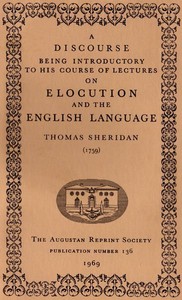
A Discourse Being Introductory to his Course of Lectures on Elocution and the English Language (1759)
Written by Thomas Sheridan
Chaptra reads alongside you — AI insights, chapter breakdowns and reader discussions for every book. Join free
About this book
Reading guide
Themes, characters and key ideas in A Discourse Being Introductory to his Course of Lectures on Elocution and the English Language (1759), written by Chaptra AI.
- about 4 hours
- advanced
- scholarly
- didactic
- persuasive
Thomas Sheridan's 1759 'A Discourse Being Introductory to his Course of Lectures on Elocution and the English Language' is a pivotal 18th-century address advocating for the systematic study and practice of elocution. Sheridan critiques the prevalent neglect of effective public speaking, arguing that a decline in oratorical skills impedes both individual refinement and national progress. He proposes a structured educational approach to mastering spoken English, drawing parallels with classical rhetorical traditions. The discourse champions the importance of oral communication over written, asserting that eloquence is fundamental for moral development, societal advancement, and the elevation of national dignity. Ultimately, it serves as a passionate call to reform English language education by integrating elocution as a core discipline.
“The neglect of elocution is a national disgrace, a bar to true eloquence, and a detriment to public discourse.”
Key themes
- The Importance of Elocution and Oratory
- This is the central theme, around which all other arguments revolve. Sheridan meticulously outlines why effective speaking is not merely an aesthetic pursuit but a fundamental skill for clear communication, persuasive argument, and the very functioning of public life. He argues that proper elocution enhances understanding, conveys emotion, and fosters conviction, making it indispensable for any educated individual or thriving society.
- The Neglect of Spoken Language
- Sheridan's discourse is largely driven by his lament over the perceived decline and lack of systematic instruction in spoken English. He identifies this neglect as a significant cultural and educational failing, arguing that it leads to miscommunication, a weakening of public discourse, and a general intellectual laziness. This theme serves as the problem statement that his lectures are designed to address.
- Systematic Language Education and Classical Rhetoric
- A core aspect of Sheridan's discourse is his proposal for a structured, systematic approach to teaching elocution, departing from haphazard or intuitive methods. He draws heavily on classical rhetorical traditions (e.g., Quintilian) to establish a rigorous curriculum for pronunciation, delivery, and persuasive speaking, advocating for formal instruction as the only way to genuinely cultivate these skills.
Worth discussing
How does Sheridan's critique of elocution's neglect resonate with contemporary communication challenges?
Chapter-by-chapter breakdowns, character arcs and the full thematic analysis come with a free account.
Discussions
No one has started one yet
Questions this book opens up
No discussions yet
Be the first to start a discussion about this book!
Sign up to start the discussionReviews
No reviews yet
Be the first to review this book!