
The AI reading companion for people who take books seriously
AI insights, chapter breakdowns, community discussions — all in one place.
A Course of Mechanical, Magnetical, Optical, Hydrostatical and Pneumatical Experiments: perform'd by Francis Hauksbee, and the Explanatory Lectures read by William Whiston, M.A.
About this book
More by William Whiston
Browse all books by this authorExplore Physics Books
Discover more Physics literature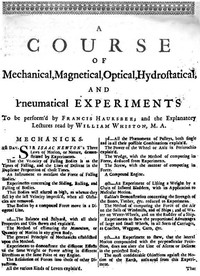
Click "Read now" to open in our Reader with AI features.
Community Discussions
Join the conversation about this book
Discussions
0 discussions
No discussions yet
Be the first to start a discussion about this book!
Sign up to start the discussionAI-Powered Insights
A clearer way to understand A Course of Mechanical, Magnetical, Optical, Hydrostatical and Pneumatical Experiments: perform'd by Francis Hauksbee, and the Explanatory Lectures read by William Whiston, M.A. through themes, characters, and key ideas
This reading guide highlights what stands out in A Course of Mechanical, Magnetical, Optical, Hydrostatical and Pneumatical Experiments: perform'd by Francis Hauksbee, and the Explanatory Lectures read by William Whiston, M.A. through 4 core themes, 2 character profiles, and 5 chapter-level ideas. It is meant to help readers decide whether the book fits their taste and deepen the reading once they begin.
About this book
A quick AI guide to “A Course of Mechanical, Magnetical, Optical, Hydrostatical and Pneumatical Experiments: perform'd by Francis Hauksbee, and the Explanatory Lectures read by William Whiston, M.A.”
Get the shape of the book before you commit: what it is about, what mood it carries, and what ideas readers tend to stay with afterward.
What the book is doing
A Course of Mechanical, Magnetical, Optical, Hydrostatical and Pneumatical Experiments is an early 18th-century scientific publication documenting a series of public lectures and demonstrations performed by Francis Hauksbee and explained by William Whiston. The work systematically presents practical experiments illustrating core principles of natural philosophy, primarily grounded in Isaac Newton's laws of physics. It covers a broad spectrum of scientific disciplines, including mechanics, optics, magnetism, fluid dynamics, and air pressure. The book serves as both a record of these influential demonstrations and a pedagogical tool aimed at elucidating complex scientific phenomena through empirical observation. Its structure progresses logically, introducing foundational concepts before moving to more specialized areas of inquiry.
Key Themes
Empiricism and the Experimental Method
This is the foundational theme, emphasizing direct observation, systematic experimentation, and repeatable demonstrations as the primary means of acquiring and validating scientific knowledge. The entire book is a testament to the power of empirical evidence over mere speculation, a cornerstone of the Scientific Revolution.
The Dissemination and Popularization of Newtonian Physics
The book serves as a pedagogical effort to explain and popularize the revolutionary ideas of Isaac Newton, particularly his laws of motion, universal gravitation, and principles of optics. Whiston and Hauksbee's course aimed to make these complex theories understandable and demonstrable to a wider public beyond elite academic circles.
“The first Part of this Course of Experiments relates to the Laws of Motion, and the universal Principle of Gravity, as settled by Sir Isaac Newton.”
How did public scientific demonstrations like those documented in this book contribute to the popularization of science in the 18th century?
See chapter-by-chapter takeaways, deeper character arcs, and a fuller literary analysis built around this book.
Unlock full AI analysis for “A Course of Mechanical, Magnetical, Optical, Hydrostatical and Pneumatical Experiments: perform'd by Francis Hauksbee, and the Explanatory Lectures read by William Whiston, M.A.”
Chapter breakdowns, character deep-dives, and thematic analysis — all in one place.
Reader Reviews
See what others are saying
Reviews
Overall Rating
Based on community ratings
No reviews yet
Be the first to review this book!
Readers Also Enjoyed
Discover more books similar to A Course of Mechanical, Magnetical, Optical, Hydrostatical and Pneumatical Experiments: perform'd by Francis Hauksbee, and the Explanatory Lectures read by William Whiston, M.A.