
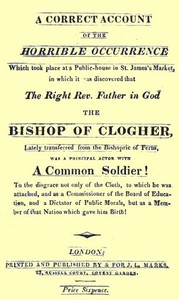
A Correct Account of the Horrible Occurrence Which Took Place at a Public-House in St. James's Market: In Which It Was Discovered That the Right Rev. Father in God the Bishop of Clogher, Lately Transferred From the Bishopric of Ferns, Was a Principal Actor With a Common Soldier! To the Disgrace Not Only of the Cloth, to Which He Was Attached, and as a Commissioner of the Board of Education, and a Dictator of Public Morals, but as a Member of That Nation Which Gave Him Birth!
Written by Anonymous
Chaptra reads alongside you — AI insights, chapter breakdowns and reader discussions for every book. Join free
About this book
Reading guide
Themes, characters and key ideas in A Correct Account of the Horrible Occurrence Which Took Place at a Public-House in St. James's Market: In Which It Was Discovered That the Right Rev. Father in God the Bishop of Clogher, Lately Transferred From the Bishopric of Ferns, Was a Principal Actor With a Common Soldier! To the Disgrace Not Only of the Cloth, to Which He Was Attached, and as a Commissioner of the Board of Education, and a Dictator of Public Morals, but as a Member of That Nation Which Gave Him Birth!, written by Chaptra AI.
- about 8 hours
- advanced
- Scandalous
- Indignant
- Critical
This early 19th-century anonymous pamphlet, "A Correct Account of the Horrible Occurrence...", meticulously details a scandalous incident involving the Right Reverend Percy Jocelyn, Bishop of Clogher, discovered in a compromising situation with a common soldier. Far from a mere report, the text serves as a scathing moral indictment, lambasting the Bishop for his egregious hypocrisy as a church leader, education commissioner, and moral arbiter. It critically examines the societal mechanisms that attempt to conceal such high-profile transgressions, particularly within the church and media. The narrative ultimately exposes the inherent class bias within the legal system and the press, urging readers to confront the profound implications of such moral failings on national integrity and public trust.
“To the Disgrace Not Only of the Cloth, to Which He Was Attached, and as a Commissioner of the Board of Education, and a Dictator of Public Morals, but as a Member of That Nation Which Gave Him Birth!”
Key themes
- Hypocrisy and Moral Corruption
- This is the central theme, directly addressed through the actions of Bishop Jocelyn. The pamphlet vividly exposes the stark contrast between his public role as a 'dictator of public morals' and his private conduct, arguing that such duplicity undermines the very fabric of society and the integrity of the church. It questions the authenticity of moral authority when wielded by those who secretly transgress.
- Social Class and Justice
- The pamphlet highlights the profound 'discrepancy in treatment' between individuals of high status (the Bishop) and those from lower classes (the common soldier). It suggests a 'biased legal system' and a 'corrupt press' that protects the powerful, thereby denying equal justice. This theme critiques the inherent inequalities embedded within the societal structures of the time.
- Public Morality vs. Private Vice
- This theme explores the tension between the outward display of virtue expected from public figures, especially moral leaders, and their private transgressions. The pamphlet argues that private vices, when belonging to public figures, inevitably become public scandals with far-reaching societal consequences, challenging the very definition of public and private spheres for those in authority.
Worth discussing
How does the pamphlet critique the role of religious leaders as moral arbiters, and is this critique still relevant today?
Chapter-by-chapter breakdowns, character arcs and the full thematic analysis come with a free account.
Discussions
No one has started one yet
Questions this book opens up
No discussions yet
Be the first to start a discussion about this book!
Sign up to start the discussionReviews
No reviews yet
Be the first to review this book!