
About this book
Reading guide
Themes, characters and key ideas in A Contribution to the Critique of Political Economy, written by Chaptra AI.
- about 20 hours
- advanced
- analytical
- critical
- dense
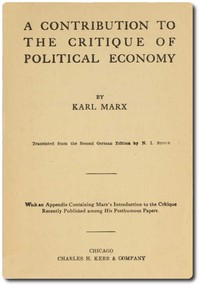
Karl Marx's "A Contribution to the Critique of Political Economy" serves as a foundational text for his later, more expansive work, *Das Kapital*. It meticulously dissects the fundamental structures of capitalist society, commencing with an in-depth analysis of the commodity. Marx systematically distinguishes between a commodity's use-value, its practical utility, and its exchange-value, its worth in trade, asserting that abstract human labor is the underlying substance of all value. The work then progresses to examine the genesis and functions of money as the universal equivalent, demonstrating its role in mediating commodity exchange and crystallizing social relations. Through this rigorous theoretical exploration, Marx lays the groundwork for understanding the inherent contradictions and dynamics of the capitalist mode of production.
“The wealth of societies in which the capitalist mode of production prevails, presents itself as 'an immense accumulation of commodities'.”
Key themes
- The Commodity as the Cell-Form of Capitalism
- Marx begins his analysis by identifying the commodity as the fundamental unit of capitalist society. He argues that understanding the dual nature of the commodity (use-value and exchange-value) is key to unlocking the secrets of the capitalist mode of production. This theme establishes the methodological starting point for his entire critique, positing that the complex social relations of capitalism are embedded within this seemingly simple economic object.
- Labor Theory of Value
- Central to Marx's analysis is the assertion that the value of a commodity in exchange (exchange-value) is determined by the socially necessary abstract human labor-time embodied within it. This theory distinguishes between concrete labor (producing specific use-values) and abstract labor (the expenditure of human labor power in general), positing the latter as the substance of value. This concept is foundational to his later theories of surplus value and exploitation.
- The Genesis and Functions of Money
- Marx meticulously traces the historical and logical development of money from the simple form of value to the universal equivalent. He argues that money is not an arbitrary invention but a necessary outcome of the contradictions inherent in commodity exchange. Money functions as a measure of value, a medium of circulation, and a store of value, thereby embodying and facilitating the social relations of production in a capitalist system. His analysis critiques the notion of money as a neutral technical instrument.
Worth discussing
How does Marx's distinction between use-value and exchange-value challenge conventional understandings of wealth and value?
Chapter-by-chapter breakdowns, character arcs and the full thematic analysis come with a free account.
Discussions
No one has started one yet
Questions this book opens up
No discussions yet
Be the first to start a discussion about this book!
Sign up to start the discussionReviews
No reviews yet
Be the first to review this book!