
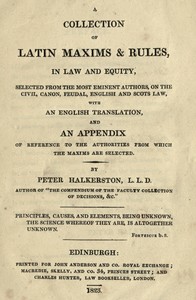
A collection of Latin maxims & rules, in law and equity : $b selected from the most eminent authors, on the civil, canon, feudal, English and Scots law, with an English translation, and an appendix of reference to the authorities from which the maxims are selected
Written by Peter Halkerston
Chaptra reads alongside you — AI insights, chapter breakdowns and reader discussions for every book. Join free
About this book
Reading guide
Themes, characters and key ideas in A collection of Latin maxims & rules, in law and equity : $b selected from the most eminent authors, on the civil, canon, feudal, English and Scots law, with an English translation, and an appendix of reference to the authorities from which the maxims are selected, written by Chaptra AI.
- about 20 hours
- advanced
- Informative
- Didactic
- Scholarly
Peter Halkerston's "A Collection of Latin Maxims & Rules, in Law and Equity" is an early 19th-century foundational legal reference work. It meticulously compiles numerous Latin maxims from diverse legal traditions—civil, canon, feudal, English, and Scots law—each accompanied by an essential English translation. Halkerston's introduction underscores the maxims' role as indispensable, foundational principles underpinning the entire legal system, advocating their memorization for effective legal practice. The book systematically presents these enduring legal adages, emphasizing that legal rules should be derived from established law, not the reverse. It serves as a crucial resource for understanding the historical continuity and practical application of core legal principles.
“Ignorantia juris non excusat. (Ignorance of the law excuses no one.)”
Key themes
- The Rule of Law and Foundational Principles
- This theme explores how legal maxims serve as the immutable bedrock of any just legal system. Halkerston posits that these concise statements encapsulate fundamental truths and principles from which all specific laws and rulings should logically derive. They represent the distilled wisdom of centuries of jurisprudence, providing a stable and consistent framework for legal interpretation and application, ensuring that law is based on reason and established precedent rather than arbitrary decisions.
- Legal Education and Practicality
- The book explicitly addresses the critical role of legal maxims in the education and daily practice of legal professionals. Halkerston argues that memorizing and understanding these maxims is not merely an academic exercise but an essential skill for lawyers to navigate their work effectively. They provide a mental toolkit, offering immediate access to core legal arguments and principles that can be applied to diverse cases, thereby enhancing a practitioner's competence and efficiency.
- Historical Continuity and Universality of Law
- By compiling maxims from civil, canon, feudal, English, and Scots law, Halkerston demonstrates that fundamental legal principles possess a remarkable historical continuity and a degree of universality across different legal traditions. This theme suggests that while specific laws and procedures may vary, certain core concepts of justice, rights, and responsibilities have been recognized and articulated in similar ways across diverse cultures and eras, forming a shared heritage of legal thought.
Worth discussing
To what extent do Latin maxims remain relevant and applicable in modern legal systems, given the evolution of law and society?
Chapter-by-chapter breakdowns, character arcs and the full thematic analysis come with a free account.
Discussions
No one has started one yet
Questions this book opens up
No discussions yet
Be the first to start a discussion about this book!
Sign up to start the discussionReviews
No reviews yet
Be the first to review this book!