
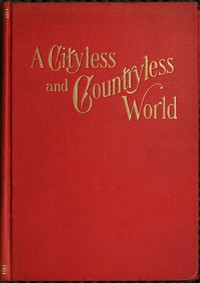
A cityless and countryless world : $b An outline of practical cooperative individualism
Written by Henry Olerich
Chaptra reads alongside you — AI insights, chapter breakdowns and reader discussions for every book. Join free
About this book
This work by Olerich, Henry offers readers a unique literary experience. The narrative explores themes of social problems and cooperation.
Reading guide
Themes, characters and key ideas in A cityless and countryless world : $b An outline of practical cooperative individualism, written by Chaptra AI.
- about 12 hours
- advanced
- Utopian
- Didactic
- Analytical
Henry Olerich's "A Cityless and Countryless World" is a foundational work of utopian literature, proposing a radical re-imagining of human society based on "practical cooperative individualism." Published in 1912, the book outlines a detailed blueprint for a future where traditional cities and rural isolation are abolished, replaced by a network of scientifically managed, decentralized cooperative communities. Olerich argues for a system that maximizes efficiency, individual freedom, and collective well-being through shared resources, rational planning, and the elimination of wasteful competition, offering a vision of harmonious living achieved through systematic social engineering.
“The cityless and countryless world will be a world of homes, of communities, of co-operation, of individualism, and of freedom.”
Key themes
- Cooperative Individualism
- This is the central philosophical tenet of Olerich's work, arguing for a system where individual liberty and self-development are not suppressed but enhanced through collective ownership, shared resources, and cooperative labor. It seeks to balance the benefits of individual initiative with the efficiencies and securities of communal living, eliminating wasteful competition while fostering personal growth.
- Scientific Management and Efficiency
- Olerich advocates for the application of rational, scientific principles to every aspect of societal organization, from agriculture and manufacturing to housing and healthcare. This theme emphasizes the elimination of waste, optimization of resources, and the use of technology to achieve maximum productivity and comfort with minimum effort, thereby improving the overall quality of life.
- The Abolition of City and Country Dichotomy
- A foundational premise of the book, this theme proposes the elimination of traditional urban centers (seen as sources of pollution, crime, and social inequality) and isolated rural living (seen as inefficient and culturally deprived). In their place, Olerich envisions a network of decentralized 'home-colonies' that integrate the best features of both – access to nature and community, combined with technological advancement and cultural opportunities.
Worth discussing
To what extent is Olerich's vision of 'practical cooperative individualism' genuinely individualistic versus communitarian? Can these two ideals truly be reconciled as he proposes?
Chapter-by-chapter breakdowns, character arcs and the full thematic analysis come with a free account.
Discussions
No one has started one yet
Questions this book opens up
No discussions yet
Be the first to start a discussion about this book!
Sign up to start the discussionReviews
No reviews yet
Be the first to review this book!