
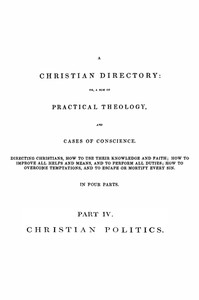
A Christian Directory, Part 4: Christian Politics
Written by Richard Baxter
Chaptra reads alongside you — AI insights, chapter breakdowns and reader discussions for every book. Join free
About this book
Reading guide
Themes, characters and key ideas in A Christian Directory, Part 4: Christian Politics, written by Chaptra AI.
- about 20 hours
- advanced
- Instructive
- Serious
- Analytical
Richard Baxter's "A Christian Directory, Part 4: Christian Politics" is a seminal 17th-century theological treatise that meticulously outlines the principles governing the relationship between Christian faith and political life. It serves as a prescriptive guide for both civil rulers and ordinary subjects, detailing their respective duties and responsibilities through a profoundly Christian lens. Baxter argues for a divinely ordained governmental authority, emphasizing an ethical framework rooted in Christian teachings for the benefit of individual souls and societal harmony. The work systematically explores how faith should inform governance, righteous living within societal structures, and the ultimate alignment of politics with spiritual and moral imperatives.
“"Government is the ordinance of God for the good of mankind, and not merely a human invention."”
Key themes
- Divine Authority of Government
- Baxter fundamentally asserts that all governmental authority originates from God. Rulers are seen as God's ministers, appointed to enforce divine law and maintain order. This theme underpins all other discussions of political duties and responsibilities, legitimizing the state's power while also placing immense moral obligations upon those who wield it.
- Christian Ethics in Politics
- The entire treatise is dedicated to outlining an ethical framework for political action, rooted in Christian morality. Baxter argues that political decisions, laws, and civic conduct must align with biblical teachings, emphasizing justice, righteousness, piety, and the common good as paramount virtues for both rulers and subjects.
- Duties of Rulers and Subjects
- Baxter meticulously delineates the reciprocal duties of those in power and those under authority. Rulers are obligated to govern fairly, protect their people, and foster spiritual welfare, while subjects owe obedience, respect, prayer, and active support to their lawful magistrates. This theme establishes a structured social contract based on divine command.
Worth discussing
How does Baxter's understanding of government's divine origin compare to modern secular views of political authority?
Chapter-by-chapter breakdowns, character arcs and the full thematic analysis come with a free account.
Discussions
No one has started one yet
Questions this book opens up
No discussions yet
Be the first to start a discussion about this book!
Sign up to start the discussionReviews
No reviews yet
Be the first to review this book!