
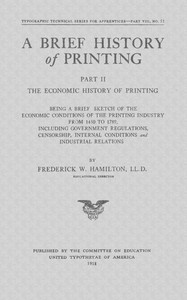
A Brief History of Printing. Part II: The Economic History of Printing
Written by Frederick W. (Frederick William) Hamilton
Chaptra reads alongside you — AI insights, chapter breakdowns and reader discussions for every book. Join free
About this book
Reading guide
Themes, characters and key ideas in A Brief History of Printing. Part II: The Economic History of Printing, written by Chaptra AI.
- about 8 hours
- advanced
- Informative
- Historical
- Analytical
Frederick W. Hamilton's "A Brief History of Printing. Part II: The Economic History of Printing" offers a meticulous examination of the economic landscape surrounding the printing industry from its inception in the mid-15th century up to the French Revolution. The work meticulously details the intricate interplay of governmental regulations, the evolving conditions of labor, and the dynamic shifts within trade guilds as printing emerged as a transformative force. Hamilton explores how early printers often operated outside traditional guild structures, navigating complex governmental oversight and fluctuating market demands. Beyond its industrial aspects, the book contextualizes printing's profound influence on societal thought and its pivotal role in subsequent revolutions, setting the stage for a deep dive into the modernization of the industry.
“No specific quotes available without direct access to the text, but would likely focus on insightful observations regarding economic trends, labor dynamics, or the impact of printing on society, such as: 'The economic autonomy of the early printer was a constant struggle against the entrenched power of guilds and the pervasive reach of state control.' or 'Apprenticeship served not merely as a training ground, but as a crucial economic and social mechanism for controlling labor supply and transmitting craft knowledge.'”
Key themes
- The Economic Impact of Technological Innovation
- This theme explores how the invention and spread of printing fundamentally altered economic structures, creating new industries, labor markets, and forms of capital. It examines the costs of production, pricing strategies, market expansion, and the overall economic landscape shaped by this transformative technology.
- Labor and Social Class in Early Modern Industry
- Hamilton delves into the socio-economic conditions of workers within the printing industry, including apprentices, journeymen, and master printers. This theme investigates the structure of labor, the division of work, the challenges of social mobility, and the daily realities faced by various classes of workers.
- Government Regulation and Economic Control
- This theme examines the extensive role of state and religious authorities in regulating the printing industry. It covers censorship, licensing, monopolies, and other forms of control aimed at managing both the economic output and the ideological content of printed materials, highlighting the constant tension between innovation and control.
Worth discussing
How did the economic structure of the early printing industry shape its output and influence?
Chapter-by-chapter breakdowns, character arcs and the full thematic analysis come with a free account.
Discussions
No one has started one yet
Questions this book opens up
No discussions yet
Be the first to start a discussion about this book!
Sign up to start the discussionReviews
No reviews yet
Be the first to review this book!