
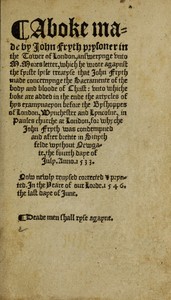
A boke made by John Fryth, prysoner in the Tower of London: answerynge unto M. Mores letter, which he wrote agaynst the fyrste lytle treatyse that John Fryth made, concernynge the sacramente of the body and bloude of Christ
Written by John Frith
Chaptra reads alongside you — AI insights, chapter breakdowns and reader discussions for every book. Join free
About this book
Reading guide
Themes, characters and key ideas in A boke made by John Fryth, prysoner in the Tower of London: answerynge unto M. Mores letter, which he wrote agaynst the fyrste lytle treatyse that John Fryth made, concernynge the sacramente of the body and bloude of Christ, written by Chaptra AI.
- about 8 hours
- advanced
- serious
- polemical
- defiant
John Frith's "A boke made by John Fryth, prysoner in the Tower of London" is a pivotal early 16th-century theological treatise, serving as a defiant response to Sir Thomas More's criticisms of Frith's reformist views on the Eucharist. Penned from prison and under the shadow of execution, the work meticulously argues for a spiritual understanding of Christ's body and blood in the sacrament, challenging the prevailing literal interpretations. Frith frames his defense by recounting a foundational conversation on the Eucharist, emphasizing that genuine faith and the essence of Christ’s sacrifice supersede the physical aspects of the ritual. The book stands as a rigorous intellectual and spiritual testament, articulating a framework for reconciling faith with Christian corporeal rites amidst the intense theological debates of the English Reformation.
“For the very essence of Christ's sacrifice is not in the outward sign, but in the inward faith of the believer.”
Key themes
- Spiritual vs. Literal Interpretation
- This is the central theological conflict explored, particularly concerning the Eucharist. Frith rigorously argues for a spiritual understanding of Christ's words ("This is my body") and the sacrament, contrasting it with More's literal interpretation which underpinned the doctrine of transubstantiation. He emphasizes that true faith apprehends the spiritual reality, not merely the physical sign.
- Faith and Salvation
- Underlying Frith's Eucharistic theology is the Protestant emphasis on *sola fide* – salvation by faith alone. He argues that the true efficacy of the sacrament, and indeed of all Christian life, stems from genuine faith in Christ's sacrifice, rather than from adherence to ritualistic practices or the physical properties of the elements.
- Authority of Scripture
- Frith's entire argument rests on his interpretation of scripture, reflecting the Reformation principle of *sola scriptura*. He positions biblical texts as the ultimate authority for understanding Christian doctrine, challenging the traditional reliance on church tradition or hierarchical interpretation.
Worth discussing
How does Frith's personal situation as a prisoner influence the tone and urgency of his arguments?
Chapter-by-chapter breakdowns, character arcs and the full thematic analysis come with a free account.
Discussions
No one has started one yet
Questions this book opens up
No discussions yet
Be the first to start a discussion about this book!
Sign up to start the discussionReviews
No reviews yet
Be the first to review this book!